Showing posts with label black history month. Show all posts

Tuesday, January 31, 2012

GMAD at 25: A History in Words and Images at Schomburg Center on Wednesday, February 1, 2012


Gay Men of African Descent (GMAD) and The Schomburg Center for Research in Black Culture present a jubilee exhibition entitled GMAD at 25: A History in Words and Images. This exhibition will celebrate 25 historic years of GMAD on Wednesday, February 1, 2012. Reception 5:30pm with exhibit & panel discussion 6:30pm to 8:00pm at the Schomburg Center for Research in Black Culture in Harlem, NY.

Attendance is OPEN TO THE PUBLIC.

GMAD is working to improve quality of life within the New York City black gay community by effectively fighting the triple threat of AIDS, homophobia and racism through education, advocacy, health and wellness and social support. Tokes Osubu, GMAD Executive Director will lead a panel discussion at the exhibition focusing on history, progress and the future of GMAD and its initiatives affecting and supporting Gay Men Of African Descent here and abroad. www.gmad.org

The crème de la crème of the philanthropic, arts and entertainment industries will be in attendance to support and honor these innovators and members of the LGBT community on their very special day.

GMAD at 25: A History in Words and Images is co-curated by Dr. Kevin McGruder, former Executive Director of GMAD and current Scholar-in-Residence at the Schomburg Center; and Steven G. Fullwood, Project Director for the Black Gay & Lesbian Archive at the Schomburg Center.

Initial funding of the LGBT Initiative provided by Time Warner Inc., with additional support from M.A.C. AIDS Fund; Arcus Foundation; and Friends of the LGBT Initiative.

RSVP: GMAD25.eventbrite.com

Monday, February 21, 2011

My Personal Inspiration: B. Scott


As the month of February continues I will continue to highlight individuals who have personally inspired me to be the individual that I am. Many people that have inspired me of color are in the arts, entertainment, and beauty world; however I am inspired in so many other ways that range from health backgrounds, political, and athletic. The next individual would have to be one of the first rising internet gaylebrities that I can think of and is still going strong. I have had the opportunity to meet this diva several times and I really do think that he deserves all the recognition he receives and really want to give him a special honor for black history month. Thank you B. Scott for all the wonderfulness you have done for our community and holding it down for all gay men of color.


B. Scott, (born Brandon Scott Sessoms on March 21, 1981) is an American television personality, radio show host and internet celebrity who is best known for his YouTube videoblogs and website lovebscott.com.
Sessoms, as B. Scott, who is openly gay, has become a popular internet personality through his visibility on YouTube and his personal website, lovebscott.com, which primarily focuses on the five pillars of Pop culture: Celebrity News, Fashion, Music, Nightlife, and Miscellaneous Entertainment. The website's intent is to approach entertainment and celebrity news with a positive spin. The name lovebscott.com was selected in an effort to give his website a readily-identifiable personality with the mission of conveying a positive outlook. In May 2007, B. Scott started incorporating YouTube videos into his website to personally connect with his readers. The videos include personal observations, celebrity news, musical performances, political commentary, interviews and messages of encouragement to the audience. The videos are produced out of B. Scott's Los Angeles residence. The YouTube site maintains a subscriber base of over 90,000, and has won numerous awards for viewership and subscriptions. B. Scott has won the Best Video Blog by The Black Weblog Awards in 2007 and 2008. In January 2008, B. Scott was selected by YouTube to become one of the company's partners.
In 2009, B. Scott created 'The B. Scott Show,' a talk/variety-style internet show that ran concurrent to the original videoblog. Interview subjects included celebrities and important figures in the LGBT community. Interviews are conducted in B. Scott's home and broadcast on both the YouTube channel and the website. Celebrities interviewed have included Ne-Yo, Ashanti, Eva Marcille, LeToya Luckett, Mariah Carey, Jordin Sparks, and Chilli (of TLC).
B. Scott’s YouTube channel has led to recognition from numerous celebrities. Popular blogger Perez Hilton in 2007 named B. Scott his “Favorite New YouTuber”. In addition, on June 19, 2009, Academy Award winner Jamie Foxx declared on his Sirius Satellite Radio channel “The Foxxhole”, “I love B. Scott. He’s very attractive. He looks like a cross between Prince, Rosario Dawson and Lenny Kravitz.” This unsolicited acclaim helped open B. Scott to a new level of recognition.

B. Scott is one of the first black gay internet gaylebrities to cross over into mainstream entertainment with appearances on The Tyra Banks Show and on the Oxygen Television Network. With all of his hard work and dedication this is one gaylebrity that is not going anywhere anytime soon
.

Thursday, February 17, 2011

Black History Month: The Nat King Cole Show & Marian Anderson

By J9 of J9's MusicLife


To celebrate Black History month, through February check out a series of features acknowledging parts of black history as it relates to music.


The Nat King Cole Show, First Variety Show to Feature Black Star


The Nat King Cole Show premiered on NBC on November 5, 1956.  It was the first TV variety show to star a major black entertainer, Nat King Cole.  Hazel Scott (in 1950) and Billy Daniels (in 1952) were black hosts who tried it before but they were as famous as Cole and didn't have much success.  Cole, at the time, was the highest paid black star in America and one of the most successful entertainers in the world.  Before the Nat King Cole Show, blacks were portrayed as dumb stereotypes like in the shows Amos n' Andy and Beulah.


The 15 minute weekly show debuted during a time when there was still legal segregation in the South.  The show didn't have commercial sponsorship because many viewers and advertisers didn't want to support a show with a black host.  Despite the low ratings and lack of national sponsors, NBC kept the show on air (oh how things have changed today).  The network fit the bill hoping this would eventually change. 

In December, the network increased the show to 30 minutes thinking this would boast ratings.  Along with Cole, the show featured other black and white musical artists such as Ella Fitzgerald, Peggy Lee, Mel Torme, Mahailia Jackson, Sammy Davis Jr., and Tony Bennett.  To support Cole and the show, many of these acts agreed to get paid minimum wage.
 

To continue reading, click here.


Marian Anderson is Denied to Sing in Constitution Hall

Marian Anderson (February 27, 1897 – April 8, 1993) was an American contralto from Philadelphia, PA.  She is known to be one of the most celebrated singers of the twentieth century.  Anderson made her debut at the New York Philharmonic on August 26, 1925 and and in 1928, she sang for the first time at Carnegie Hall.

In 1939, Anderson became an important figure in the struggle for racial equality when she was denied permission by the Daughters of the American Revolution (DAR) to sing to an integrated audience in Constitution Hall, in Washington, D.C. cause of her race.

The public was outraged, famous musicians protested, and First Lady Eleanor Roosevelt resigned from the DAR.  With the help of Roosevelt and the NAACP, Anderson gave a free open-air concert on the steps of the Lincoln Memorial.  With Lincoln as her backdrop, she sang My Country 'Tis of Thee before a crowd of 75,000 people and million of radio listeners.  This performance is considered one of the most dramatic civil-rights spectacles ever.


To read more click here.

Thursday, February 10, 2011

Black History Month: Francis Johnson & Betty Carter

By J9 of J9's MusicLife


To celebrate Black History month, through February check out a series of features acknowledging parts of black history as it relates to music.


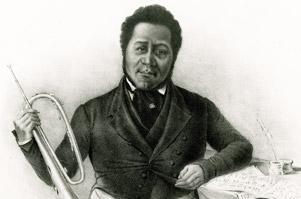
Francis Johnson, Band Leader & Composer


Francis "Jack" Johnson (1792–1844) was an African-American musician and composer during the Antebellum period.  Being an African-American composer was rare in the U.S. during this time.  Some say he was born in Martinique in the West Indies and moved to Philadelphia as an adult.  Johnson played many instruments including the keyed bugle, cornet, and violin.  He wrote more than 300 compositions of various styles—operatic airs, Ethiopian minstrel songs, patriotic marches, ballads, cotillions, quadrilles, quicksteps, and other dances.  Today he's considered one of the "founding fathers" of the American musical style.

Johnson was the first:
  • African-American composer to have his works published as sheet music.
  • African-American to give public concerts.
  • to participate in racially integrated concerts in the U.S.
  • African-American musician and probably the first American musician to tour Europe with a band.

To read more and listen to some of Johnson's pieces, click here.


Betty Carter, The Godmother of Jazz

Betty Carter (1929 - 1998) was born Lillie Mae Jones in Flint, Michigan. Her father led a church choir and her mother, like most religious African-Americans during that time, believed Jazz was "the devil's music."  As a kid, Carter studied piano at the Detroit Conservatory and as a teenager, went pro after winning a talent contest.  Later, she became a regular on the local club circuit, singing, and playing piano.

By the age of 20, Carter moved to New York and started touring with Lionel Hampton.  This is also the time she honed her scat singing ability.  Hampton was behind creating her stage name as it came from his nickname for her, "Betty Be-Bob".

Carter later went on to sing and tour with Charlie Parker, Dizzy Gillespie, Miles Davis, and Ray Charles.  She also did a series of duets with Charles including the classic, Baby It's Cold Outside.  Carter was known for her improvisational technique and idiosyncratic vocal style.  It was said she used her voice like a musical instrument.


To read more and view a clip of her singing, click here.

Monday, February 7, 2011

Personal Inspiration: Merrell Hollis


So in honor of Black History Month I have decided to recognize individuals that have inspired me on a personal level. Each Monday of the month I have selected a different person who I have had a personal experience with and are most likely very involved in our community. The first individual that I would like to recognize is a make-up artist who is truly an amazing talent, humble, and has inspired my own creativity and talents in the artistry world.

From runway to print; from stage to screen, the colorful expertise of Merrell Hollis brushes the faces of the famous.

Merrell is currently Key Groomer for Bad Boy Entertainment. Not only is he on call for Sean 'P. Diddy' Combs, he is responsible for the make-up and grooming of Bad Boy artists.

From Fall 2004 through Spring 2005, Merrell was the Key Make-up Artist for 'Full Plate', a series on the new lifestyle & entertainment channel, TV One.

Other television programs on which Merrell's artistry has been displayed are Oprah, Americas Next Top Model, Entertainment Tonight, MTV's Video Music Awards, TRL, The Early Show, Ambus
h Makeover and numerous BET shows.

Music videos for Ludacris, Snoop Dogg, Nelly, G-Unit and 112 are just a few in which his creative talents have been featured.

For nearly a decade, Merrell honed his skills with various upscale clients such as Paul Mitchell Hair Care System, Saks Fifth Avenue, Clinique Cosmetics, MAC Cosmetics, Bobbi Brown, Lancome, Borghese and Versace.

His work has been showcased in publications such as GQ, Rolling Stone, Vanity Fair, VIBE, Essence and Men's Fitness.

Merrell earned a degree in Fashion Marketing Design from American Inter-Continental University. He also studied esthetician/skin care at the International School of Skin and Nails.

Most recently you can see Merrell's work daily on the Wendy Williams Show.


Here is where Nathan Seven Scott and I had the opportunity to recognize him as Man of the Month. It was very exciting and Wendy Williams had great things to say about him as well.


Thursday, February 3, 2011

Black History Month: Hallelujah! and Treemonisha

By J9 of J9's MusicLife


To celebrate Black History month, through February check out a series of features acknowledging parts of black history as it relates to music.


Hallelujah!, One of the First All-Black Movies


Hallelujah! is a 1929 MGM musical directed by an American, King Vidor.  It was one of the first all-black "talkie" movie from a major studio.  Vidor directed it without pay when MGM thought white audiences wouldn't see a movie with black actors in lead roles. Filmed in Tennessee and Arkansas, most of it was shot silent with sound added later in the studio. 

It contained both spiritual (Go Down Moses (Let My People Go), Sometimes I Feel Like a Motherless Child) and jazz numbers (Swanee Shuffle, as seen in the clip below).  Vidor wanted to show the role religion and music played in the South, a place he grew up in himself.


By combining sex, murder, religion, and of course music, Hallelujah! tells the story of Zeke, a poor cotton farmer who struggles with religion and his relationship with a seductive jazz singer named Chick. 

To read more and find out what the film was all about, click here.


Treemonisha, a Black Jazz-Folk Opera


Treemonisha, an opera by African-American composer Scott Joplin in 1910, is considered to be the most American opera ever composed.  His goal was to inspire African-Americans during that time and pose the idea that education would create racial equality.  Published in 1911, Joplin sent a copy of the score to the American Musician and Art Journal, who's review called the opera an "entirely new phase of musical art and... a thoroughly American opera (style)."

Although many label Treemonisha a ragtime opera, Joplin wanted his piece to have the seriousness found in the Metropolitan Opera and other European companies as well as the entertaining elements of ragtime.  He called this a grand opera with an overture, instrumental prelude, solo arias, duets, ensemble pieces, and recitative.  It contained forms of rag, barbershop quartet, sentimental ballad, waltz, march, and ensemble finales.  Songs were made up of black folk and dances, pre-blues music, spirituals, and a call-and-response style.

To read more and view a clip of the opera, click here.

THEFUTUREFORWARD.NET HEADLINES

The FUTURE

LinkWithin

Blog Widget by LinkWithin